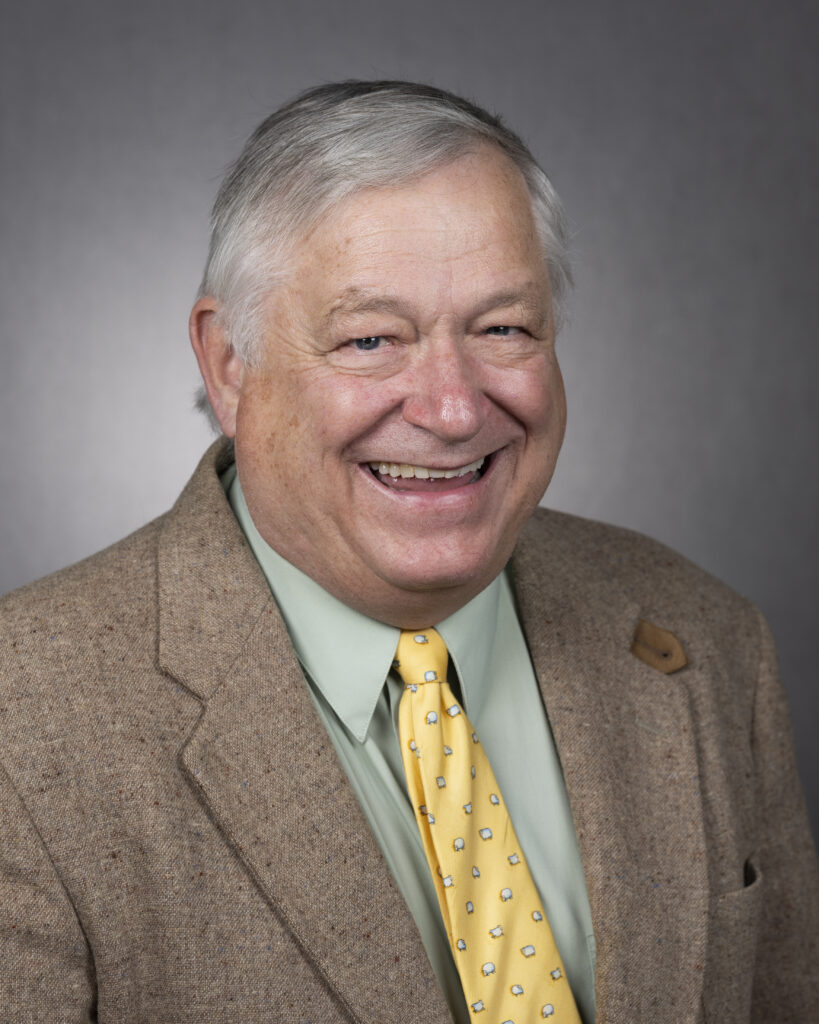

Meet Dr. Peter J. Hansen
Written by Dr. Dawit Tesfaye (SSR Community & Engagement Committee) in honor of the Month of the Mentors Appreciation.
January is a Mentors Appreciation Month. The SSR Community & Engagement Committee is participating in this celebration. For this, Dr. Dawit Tesfaye (member of the SSR Community & Engagement Committee) interviewed Dr. Peter J. Hansen, Distinguished Professor, Department of Animal Sciences, University of Florida, USA.
DT: What experiences shaped your approach to mentorship, and how would you describe your mentoring philosophy?
PJH: From my earliest time in a research lab, I have made it a point to learn from those around me and figure out what people do right and what they do wrong. I owe the most to my graduate mentor, Edward Hauser, who taught me how to be a scientist and who, even when I was a graduate student, got me to think about how I would mentor my own students. Since becoming a professor, I have learned so much from colleagues such as Bill Thatcher who are excellent graduate mentors.
Just a few thoughts about my mentoring philosophy – I want my students to be critical and free thinkers, to have an intellectual framework for doing experiments, to work hard, to love what they are doing, to be unafraid and to be joyous. I try to create conditions where these goals can be met. it is important to develop a program that allows the student to meet his or her goals and not just yours. Students are all individual human beings with their own hopes and desires. They are someone’s son or daughter. They deserve all the mentor’s efforts to help them succeed.
DT: How do you support the professional and personal development of your trainees?
PJH: The most important thing is to buy into each of your students – whether they are good or bad or whether you like them or don’t like them. Devote the time it takes for them to succeed. Be willing to sacrifice for your students. Get to know each student and learn their personality, background, strengths, limitations, and goals. Make their graduate career about them and not about you. No one goes to graduate school so that their major professor can get a grant. Practice what you preach – live your life according to the same standard you expect your students to live under. Be loyal to them.
The second thing I try to do is to teach students a formal approach to the practice of science – a philosophy of how to do experiments that advance scientific knowledge. I do this in journal clubs, individual meetings, at seminars, in the hallway and every way I can.
The third thing I do is to try to make science fun! I celebrate victories large and small and minimize the impact of failure (which comes to everyone). Why do science at all if it does not instill occasional joy?
DT: How do you foster an inclusive, supportive, and productive research environment in your lab or program?
PJH: I like people and enjoy seeing people thrive. I try to build student’s self-confidence and love for science. I celebrate the things that make each student a unique individual and develop a graduate program that lets each student utilize their strengths. I help them be thick-skinned, unafraid of failure, and able to take criticism. I try to teach students that science is not just about personal success but also about advancing human development. We do good in the world.
DT: What does successful mentorship look like to you?
PJH: Bill Thatcher told me it was not necessary for each of your students to be a world-class scientist for you to be a successful mentor. If you help each of your students reach their full potential and their goals in life, you have succeeded as a graduate mentor. Bill was right.
DT: What advice would you give to early-career faculty who are beginning to mentor students?
PJH: think about how to be a good major professor – develop a coherent strategy to use as a graduate mentor and refine the strategy over time as you see what works for each individual student, 2) experiment – see what works and what doesn’t work for you, 3) observe others – good and bad mentors – and learn from them and 4) talk to good mentors and get advice.
Additionally – if you are interested, I wrote a paper about mentorship that fleshes out many of my ideas about graduate education – see J Anim Sci. 2023 Jan 3;101:skad136. doi: 10.1093/jas/skad136.
Also, believe it or not, a lecture I gave on the topic got recorded and is on YouTube