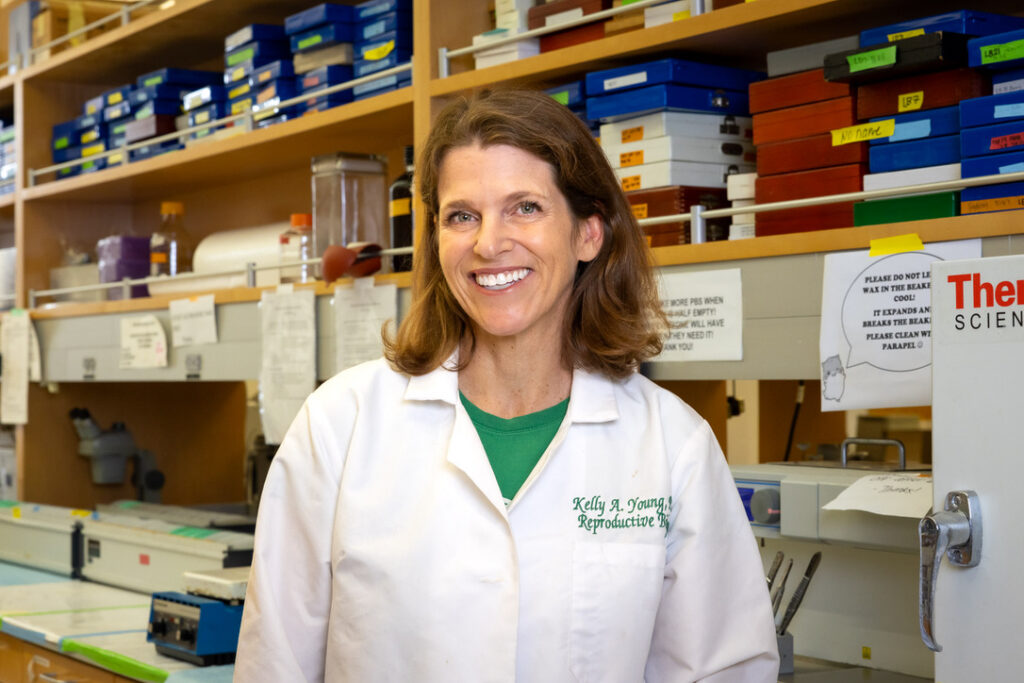

Meet Dr. Kelly A. Young
Written by Dr. Lisa Vrooman (SSR Community & Engagement Committee) in honor of the Mentors Appreciation Month.
January is a Mentors Appreciation Month. The SSR Community & Engagement Committee is participating in this celebration. For this, Dr. Lisa Vrooman (member of the SSR Community & Engagement Committee) interviewed Dr. Kelly A. Young, Professor of Biological Sciences, California State /University Long Beach, CA USA.
LV: What experiences shaped your approach to mentorship, and how would you describe your mentoring philosophy?
KY: Mentoring to me is an incredibly complex process of providing training, support, and guidance to a trainee who is simultaneously broadening my own perspective and contributing to my own growth as a mentor. I have had the privilege of mentoring undergraduate researchers in my reproductive biology research laboratory at California State University Long Beach since 2003 and these experiences have been transformative for me personally and professionally and I am beyond proud of the accomplishments of all of my mentees. One of the most rewarding aspects of mentorship is this shared growth and how the path that this takes is different for each mentee who joins the research team.
My commitment to learning how to mentor positively and inclusively is directly shaped by the generous mentorship I received. I had amazing mentors through graduate school and my post doctoral training. In particular, Drs. Dick Stouffer, Mary Zelinski, and Jon Hennebold at OHSU’s Oregon National Primate Research Center showed me that being an impactful scientist and leader can coexist with kindness and genuine support of trainees. As a trainee, I felt so welcomed by the SSR community, and it has been especially meaningful to bring my undergraduate researchers to SSR meetings to present their work—and then to have them thrive as graduate students, postdocs, or leaders of their own laboratories.
LV: How do you support the professional and personal development of your trainees?
KY: Building a trusting relationship is paramount and I believe that having this trust is one aspect that distinguishes mentorship from skill training alone. A strong foundation for mentoring is developed when students know that we are there to support them as they develop, when we will follow through, and when we understand that growth can be challenging and that career development isn’t always linear. As trust develops, I can better encourage their curiosity, boost their confidence to take on challenges, and help them through setbacks and frustrations when things invariably don’t work out the first (or fifth…) time. With a strong foundation in place, students take on increasing ownership of their projects, and I intentionally talk about their evolution as researchers to acknowledge and celebrate that growth.
Consistent check ins and deliberate backwards planning for their career goals are also central to supporting the intertwined personal and professional development of my undergraduate mentees. When students join the laboratory, our first meeting often starts with their anticipated graduation date and career goals. Together, we draft a timeline that overlays their professional plans with research goals and consider when their graduate school applications are due, when a poster presentation might strengthen their CV, or by when they would need to have enough data for an abstract. We then take a realistic look at the work required to meet those goals, revising the plan as needed based on their academic, work, and family responsibilities. As projects progress, we revisit and adjust this timeline, always with an emphasis on identifying and celebrating growth—whether personal or professional.
LV: How do you foster an inclusive, supportive, and productive research environment in your lab or program?
KY: I consider myself a work in progress as a mentor- I continue to learn and refine my mentoring skills as I adjust to the unique needs of new mentees, and I set goals not only to accomplish research outcomes but also to support my current team of undergraduates. My goal is to create a space where all mentees feel both valued and positively challenged to grow.
To move towards this goal, I start with listening. Taking the time to listen helps me better meet mentees where they are and support them as they continue along their individual paths. I also own up and apologize when I have made a mistake, and I take responsibility for addressing issues head-on. I don’t do this perfectly, and these practices aren’t easy, but I think that they are essential to foster a healthy environment. Normalizing the challenges of research, undergraduate life, and responsibilities outside the laboratory is another key part of building a positive laboratory. Experiments don’t always work, reviewers aren’t always constructive, even great hypotheses fail. Sometimes mentees see these setbacks as proof that they don’t belong, which is something that really resonates with me. I try to counter this narrative by helping mentees trust their ability to learn, problem solve and persevere. Ultimately, I work to maintain a positive laboratory environment through flexibility, respect for my mentees and their experiences, and consistent support as they navigate challenges.
LV: What does successful mentorship look like to you?
KY: Successful mentoring looks like a relationship that is grounded in mutual respect and is filled with listening, asking questions, teaching, planning, commiserating, training, adjusting, and celebrating. It looks like former mentees thriving as their authentic selves in careers that they are passionate about, and it looks like current mentees feeling empowered to make their next move that was once daunting to them- be it attempting a protocol on their own, presenting their work, reaching out to a potential future mentor or employer. I think it’s all about contributing positively to a process that allows mentees to shine with their own light and in time become mentors who inspire and guide others.