

Meet Dr. Angela Gonella-Diaza
Written by Dr. Camilo Pena-Bello (SSR Community and Engagement Committee) in honor of the National Hispanic Heritage Month
National Hispanic Heritage Month is annually celebrated from September 15 to October 15 in the United States to recognize the contributions and influence of Latinx people to the history, culture, and achievements of the United States. In celebration of Hispanic Heritage Month, Community and Engagement Committee member Dr. Camilo Pena-Bello interviewed Dr. Angela Gonella-Diaza, Associate Professor in the Department of Animal Sciences at the University of Florida, based at the North Florida Research and Education Center in Marianna, Florida, USA.
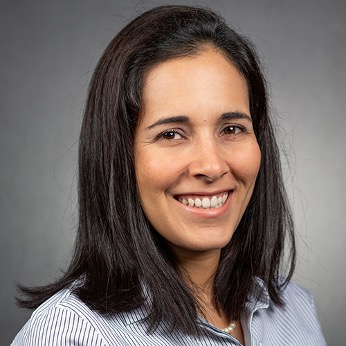
- What is your current position, and what does it entail?
I have just been promoted to Associate Professor in the Department of Animal Sciences at the University of Florida, based at the North Florida Research and Education Center in Marianna, Florida, in the Florida Panhandle. My appointment is 70% research and 30% Extension. My research focuses on improving reproductive efficiency in beef cattle through reproductive physiology and biotechnology.
- Can you tell us a bit about yourself? Where are you from? What first attracted you to reproductive biology research? And how did you get to be in your current position?
I am originally from Colombia, the country in South America. It’s Colombia, not Columbia! (LOL). I was raised in agriculture. Today, my family farm is dedicated entirely to rice production, but when I was growing up, we also raised beef cattle. Since I was a child, I have been surrounded by animals and agriculture. Agriculture has always been a big part of my life, so it was clear to me that I wanted to pursue a career related to animal and agricultural sciences. One of my uncles was a veterinarian, and during my last years of high school, I spent a lot of time visiting farms with him. That was my first exposure to rectal palpation, artificial insemination, and embryo transfer. Watching him work, I knew I wanted to become a veterinarian.
I attended vet school at UDCA in Bogotá, Colombia. During that time, I had the opportunity to volunteer in an IVF laboratory under the supervision of Dr. Liliana Chacón Jaramillo and Dr. Sandra Milena Bernal. I originally planned to stay only one summer, but I loved it so much that I continued volunteering there for nearly 3 years. Every free moment I had, I was in that laboratory. Those experiences really introduced me to reproductive biology and sparked my passion for research.
After vet school, I completed a master’s degree at the National University of Colombia under the mentorship of Dr. Aureliano Hernández and Dr. Henry Grajales. That was my first real opportunity to study reproductive physiology and molecular biology, and it opened the door to basic research. Dr. Mario Binelli from the University of São Paulo was one of the external members of the committee and he invited me to pursue a Ph.D. in his laboratory. It took me about 2 years to make that happen because I was working as a lecturer at the Universidad Cooperativa de Colombia while waiting to receive a scholarship. Fortunately, I was awarded a CAPES scholarship through the PEC-PG program for Latin American students, and in 2013 I began my Ph.D. at the University of São Paulo.
Honestly, that was one of the best experiences of my life. I combined applied field research (reproductive management, ultrasonography, embryo transfer, tissue collection, and uterine cytology) with advanced laboratory techniques such as PCR, Western blotting, cell culture, Immunohistochemistry, and RNA sequencing. My Ph.D. focused on understanding how the endocrine profile of cows undergoing timed artificial insemination protocols influences the oviductal environment and affects fertility. I was probably not the typical Ph.D. student because during graduate school we welcomed our first daughter, Nina. Balancing graduate school and family life was challenging, but I had incredible support from my husband, family, advisor, and labmates.
After earning my Ph.D., I completed a postdoctoral fellowship funded by CNPq while seeking faculty positions. During that time, we were also expecting our second child, Guillermo, so life was busy. Eventually, I applied for my current position at the University of Florida. Looking back, that period was the busiest time of my life: I was finishing my postdoctoral training, interviewing for faculty positions, raising a young daughter, expecting our second child, and trying to balance everything at once. Whenever people ask me how I managed it, I always say that if I could get through that period, I can get through anything.
I joined the University of Florida in 2019. Shortly afterward, Hurricane Michael and then, about a year later, COVID-19 arrived. It certainly wasn’t the easiest way to begin a faculty career, but those challenges also helped shape me into the scientist and Extension specialist I am today.
- What is the focus of your research program and your extension program?
My research focuses on reproductive physiology, with the overall goal of understanding how the maternal environment influences fertility and offspring long-term performance. We study reproductive physiology, embryo development, developmental programming, reproductive technologies, and biomarkers that can improve reproductive efficiency in beef cattle.
The other 30% of my appointment is Extension. I know many SSR members may not be familiar with Extension, so let me briefly explain what it is. Extension is about translating scientific discoveries into practical solutions that producers can use on their farms. My Extension program focuses on helping beef cattle producers improve the reproductive efficiency of their herds. We work closely with producers to implement reproductive technologies such as artificial insemination, estrous synchronization, embryo transfer, and pregnancy diagnosis. Every year, we work with farms throughout Florida, evaluating their reproductive performance, identifying opportunities for improvement, and developing management strategies tailored to each operation’s specific needs. The goal is to help producers increase reproductive efficiency while improving the overall profitability and sustainability of their herds.
- What do you see as the future for research in reproductive biology, including agricultural animals?
First, as someone who works closely with beef cattle producers, I believe that any technology that makes reproductive biotechnologies easier to adopt will have a tremendous impact on the industry. One of the biggest differences between beef and dairy operations is that dairy farms can implement reproductive technologies more easily because animals are managed daily. In beef production, every intervention requires gathering cattle, bringing them through the chute, and investing additional labor and time. Therefore, technologies that reduce handling while maintaining or improving reproductive efficiency will be very valuable.
Second, and I have to admit that I may be a little biased because this is one of my favorite research areas, I believe developmental programming has enormous potential. Understanding how the maternal environment influences embryo and fetal development could fundamentally change how we think about beef production. In our own research, we have shown that supplementing methyl donors during early pregnancy can improve average daily gain, increase testicular development, and even influence carcass characteristics in the offspring. I believe these epigenetic mechanisms represent an exciting opportunity to improve animal productivity and efficiency.
Finally, I think precision livestock production will become increasingly important. I would love to identify reliable biomarkers for traits such as early pregnancy diagnosis, embryo mortality, superior fertility, and feed efficiency. Genomic markers have already transformed livestock breeding, but I believe combining genomics with other types of biomarkers, including sensors, RNA, proteins, metabolites, and microRNAs, will improve our ability to identify superior animals and make more informed management decisions.
- How important has your involvement in scientific societies been to the development of your career?
It has been extremely important. I really enjoy being involved with organizations such as SSR and the American Society of Animal Science (ASAS). These meetings are where you meet new colleagues, establish collaborations, learn new techniques, exchange ideas, and stay up to date with the latest scientific advances. I truly believe my career and research program have benefited tremendously from participating in these societies. They have opened doors to collaborations and friendships that would not have happened otherwise.
Because of that, I always encourage my students to attend scientific meetings, present their work, and become actively involved. Networking is just as important as publishing papers, and these meetings are one of the best places to grow as a scientist.
- Are there ways in which you think your heritage has affected your perspective or career trajectory?
My heritage is a fundamental part of who I am. I am Latina, and I always joke that I’m more Colombian than an arepa! (LOL). Growing up in Colombia shaped the way I see agriculture, science, and life.
I inherited many values from my family. Like my grandmother, I learned to be resourceful. Like my grandfather, my mother, and my uncles, I learned the value of hard work. I carry many of those values, and many characteristics of my family and my country, with me every day.
My experiences in Colombia, Brazil, and now the US have given me different perspectives that have enriched both my personal life and my career. Having lived and worked in three different countries has also allowed me to understand agriculture from different perspectives. I understand the realities faced by producers and families who depend on agriculture for their livelihoods, and that helps me keep my research focused on solving problems that matter to producers.
- What words of inspiration would you like to share with the future generation of scientists, especially those coming from diverse backgrounds?
My first piece of advice is simple: Yes, you can. There will be many moments when you doubt yourself or think that something is impossible. During those moments, always remember that yes, you can.
Second, dream big. If someone had told me ten years ago that I would become a faculty member at the University of Florida, I would have said, “No way!” Yet here I am today, doing a job that I absolutely love. Sometimes life takes you to places you never imagined, so don’t limit your dreams.
Third, take advantage of every opportunity. This is something I constantly tell my students. Attend every seminar, enjoy every conference, talk to your committee members, ask questions, and make the most of every learning opportunity. Graduate school is one of the best times in your career to learn and grow. Believe me, once you become faculty, you’ll wish you had more time to read papers, attend seminars, and participate in conferences.
Finally, enjoy the journey. Graduate school can be challenging, and there will be difficult moments. But try to enjoy the experience as much as possible because one day you’ll look back and realize those years helped shape who you are. You’ll probably miss them more than you think.